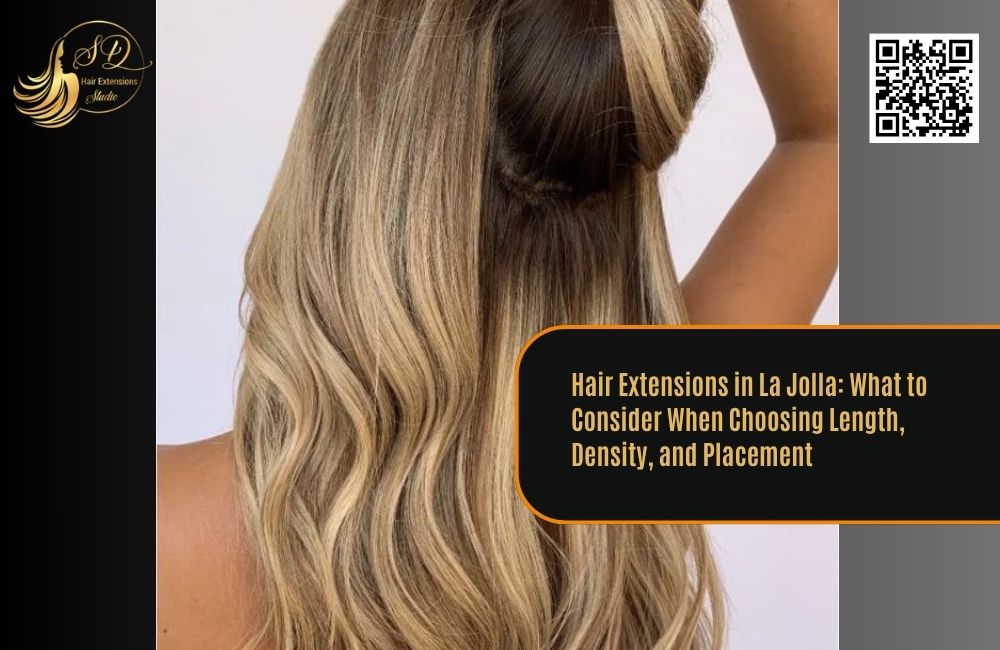
Hair Extensions in La Jolla: What to Consider When Choosing Length, Density, and Placement
Choosing Hair Extensions La Jolla clients can comfortably wear involves more than deciding how long the finished style should be. Length, density, placement, natural hair condition, texture, and everyday styling habits all influence whether extensions look integrated or noticeably added. A successful result should complement the hair you already have while giving you the extra length or fullness you want.
For someone considering extensions for the first time, understanding these factors before installation can prevent unrealistic expectations. Instead of starting with a photograph and trying to reproduce it exactly, it is more useful to understand why a certain extension plan works for your individual hair.
Start With What Your Natural Hair Can Support
The condition of your natural hair should guide every major extension decision.
A stylist needs to consider strand thickness, overall density, current length, haircut, texture, and any areas that are noticeably finer than others. The amount of extension hair suitable for thick, shoulder-length hair may be very different from what works for fine hair with less density around the temples.
Adding more hair is not automatically better. Extension weight needs to be distributed appropriately so the finished style feels balanced.
A professional consultation should therefore begin with your natural hair rather than with the extension catalog.
Choose Length by Looking at the Starting Point
Long extensions can create a dramatic transformation, but the difference between your natural length and desired extension length affects how difficult the blend will be.
Someone whose natural hair already reaches below the shoulders generally has more length available to blend into longer extensions. A person with much shorter hair may need additional density, careful layering, or a more moderate first length.
The current haircut matters too.
Blunt ends can create a visible line over longer extension hair. Layered natural hair may transition more easily, although the exact result depends on density and texture.
Instead of asking only, “How long can I go?” a more useful question is, “What length will look proportionate with my current hair?”
Think About How the Length Fits Your Daily Routine
Desired length should also make sense outside the salon.
Very long hair requires more time for washing, drying, detangling, and styling. If you exercise frequently, spend time near the coast, travel often, or prefer quick morning routines, that additional maintenance deserves consideration.
La Jolla’s coastal lifestyle can include beach days, outdoor dining, walking, fitness, and regular sun exposure. Longer extension hair has more surface area exposed to wind, salt, friction, and environmental dryness.
That does not mean active clients need short extensions. It simply means lifestyle should be part of the length decision.
Density Determines Whether the Result Looks Balanced
Length gets most of the attention, but density often determines whether an extension transformation actually looks convincing.
If thick natural hair is paired with too little extension hair, the added lengths may look narrow underneath a fuller upper section. This can make the natural ends more noticeable.
Fine hair presents the opposite challenge. Adding excessive density can overwhelm the natural hair and create unnecessary weight.
A skilled Hair Extensions Salon in La Jolla should evaluate how much hair is required to continue your natural density through the desired length without creating an artificial-looking shape.
Volume and Length Are Different Goals
Not everyone needs extensions primarily for length.
Some clients already like their natural length but want fuller sides, denser ends, or more body throughout the hairstyle. Others want significant additional length and therefore need enough extension density to support that change.
Explaining your priority during consultation makes planning easier.
If fullness is the main concern, the stylist may concentrate extension hair where the natural density feels weakest. If length is the priority, the plan must create a continuous transition from the natural perimeter into the longer hair.
The amount and distribution should reflect the goal rather than follow the same formula for every client.
Placement Is What Makes Extensions Work in Motion
Extensions are not viewed only while the hair is perfectly styled and facing forward.
People turn their heads, tuck hair behind their ears, change their part, wear ponytails, create half-up styles, and move throughout the day. Placement should account for all of these situations.
Attachments placed too close to an exposed hairline can become difficult to conceal. Placement that ignores a client’s usual part may create the same problem.
This is why the best extension map is personalized.
Before installation, explain how you normally wear your hair rather than showing only the style you want for special occasions.
The Hairline Requires a Lighter Approach
Hair around the temples and front hairline is often finer than hair through the back of the head.
These sections may not be appropriate for the same extension weight or attachment pattern used elsewhere.
Strategic placement can add fullness around the face while respecting the natural density available for coverage. In some cases, leaving certain delicate areas extension-free creates a more believable result.
A seamless installation is not about placing extensions everywhere. It is about knowing where additional hair will have the greatest visual benefit.
Texture Influences Both Density and Placement
Straight, wavy, curly, fine, and coarse hair behave differently once extensions are introduced.
For example, natural waves create movement and visual volume, so density should be evaluated when the hair is worn in its typical texture. Very straight hair can reveal differences in length and layering more clearly.
Texture also affects how extensions fall around attachment areas.
Someone who usually air-dries wavy hair should tell the stylist rather than arriving with temporarily straightened hair and planning an installation around that appearance alone.
The goal should be a blend that works with the texture you actually wear.
Color Can Change How Dense Extensions Appear
Color and density are closely connected visually.
Dark, uniform hair can sometimes show differences between natural and extension lengths more clearly because the silhouette is easy to see. Dimensional color, such as highlights or balayage, creates movement that can visually soften transitions.
This does not mean hair needs to be highlighted for extensions.
It means color matching should be considered alongside density and placement. Multiple extension shades may be used when necessary to reproduce natural variation rather than creating one flat block of color.
Your Preferred Hairstyles Should Influence the Plan
If you regularly wear a high ponytail, tell your stylist. If you almost always wear a center part, mention that too. The same applies to low buns, braids, side parts, and half-up hairstyles.
Attachment placement can influence which styles are easiest to wear discreetly.
A consultation is therefore partly about understanding your routine. A technically successful installation may still feel inconvenient if it prevents you from wearing the hairstyles you rely on every week.
Consider Maintenance Before Choosing More Hair
Greater length and density also mean more hair to maintain.
Longer, fuller extensions require additional time for brushing, washing, conditioning, and drying. Attachment areas also need appropriate care according to the method being worn.
If your schedule is already busy, discuss how much maintenance you realistically want to manage.
Choosing a slightly more moderate transformation that you can maintain consistently may provide a better experience than selecting maximum length and density based only on the initial appearance.
What Should You Bring to a Consultation?
Inspiration photographs can be helpful because they communicate the general look you like. However, they work best as conversation starters rather than exact templates.
Two people can have very different starting hair while requesting the same finished style.
A specialist should explain which elements of the reference image are realistic for your natural density, length, texture, and color. If adjustments are recommended, ask why. Understanding the reasoning helps you make a more informed choice.
Frequently Asked Questions
Is More Extension Hair Needed for Longer Lengths?
Often, yes. As the difference between natural and extension length increases, enough density is usually needed to create a convincing transition. The exact amount varies according to natural hair thickness and haircut.
Can I Get Extensions Mainly for Fuller Ends?
Yes. Extensions can be used to improve density without creating a dramatic increase in length. This can be useful when the ends appear thinner than the upper sections of the hair.
Does Fine Hair Limit Extension Placement?
Fine hair may require lighter, more strategic placement because there needs to be enough natural hair to support and conceal each attachment. A professional assessment is important before choosing a method.
Can Extensions Work With a Side Part?
Yes. Your usual part should be considered when the placement plan is created so attachment points remain discreet during everyday styling.
Should I Choose My Extension Length Before the Consultation?
You can arrive with a preferred length, but it is helpful to remain flexible. Your natural hair, desired density, maintenance expectations, and blending requirements may make another length more practical.
Build the Result Around Your Own Hair
The most natural-looking extensions are rarely created by selecting length first and solving everything else afterward. Length, density, placement, texture, color, haircut, and lifestyle need to work together.
For someone considering extensions in La Jolla, a detailed consultation can help turn a general idea into a realistic plan. Pay attention to how much hair your natural density can support, how attachments will fit your usual hairstyles, and how much maintenance your chosen length will require.
Hair Extensions San Diego Studio in nearby Cardiff works with clients seeking personalized extension solutions throughout the San Diego area. The most important starting point, wherever you choose to have your extensions installed, is a plan designed around your own hair rather than a one-size-fits-all transformation.
San Diego Hair Extensions Studio
Address: 2151 Newcastle Ave, Cardiff, CA 92007, United States
Phone: +1 858-205-2043
